Climate in Iceland – past, present and future
This is a summary of how Iceland’s climate has changed and what changes can be expected in the future. The information is based on the Scientific Committee on Climate Change’s summary report from 2023 and on data published in Iceland’s Climate Atlas.
Iceland’s weather is heading for conditions by the end of the century that will be entirely unlike anything seen since the settlement. Possibly without precedent since the last ice age ended, …
Scientific Committee on Climate Change, 2023
How has Iceland’s climate changed?
In recent decades there has been considerable warming in Iceland, precipitation patterns have changed, glaciers have retreated and sea level has changed across the country.
Temperature
Since the beginning of the 20th century, the average temperature in Iceland has risen by 1°C compared with the period 1850–2020. The warming has been greater in winter than in summer. The first two decades of the 21st century were the warmest in Iceland since measurements began. The ocean around the country has also warmed significantly in recent decades, although considerable fluctuations have been measured.
Precipitation

Precipitation has increased in recent decades. In recent years, average annual precipitation was 5–10% higher than in the period 1971–2000. The proportion of snow in precipitation has been decreasing, particularly in lowland areas but also in the highlands.
Glaciers

The area of glaciers in Iceland has decreased by 19% since the end of the 19th century, when they reached their greatest extent. Several glaciers have disappeared entirely, proglacial lakes have grown and new ones have formed.
Sea level

Sea level in Reykjavík has risen by an average of 2.3 mm per year over the period 1956–2020 (uncertainty 1.8–2.8 mm). Sea level changes around Iceland are determined by changes in land elevation, ocean warming and mass loss of ice sheets in Antarctica and Greenland. The changes therefore vary greatly between regions, and sea level has variously risen, fallen or remained unchanged.¹
How will Iceland’s climate change?
Average temperature will rise, in both winter and summer. Summers will be warmer and drier. Winters will be milder and wetter. Extreme precipitation will become more frequent and more intense, in both winter and summer. Glaciers will continue to retreat. Sea level will change in certain areas, either rising or falling. Snow and frost periods will become less frequent. The weather will remain variable – even more variable than now. How well we succeed in reducing greenhouse gas emissions will determine how serious the changes become.
Temperature through the century
Iceland’s climate will continue to warm, particularly in winter. This does not rule out cold spells. Projections show that by the middle of the century, warming will be in the range of 1.0–1.7 °C compared with the 1981–2010 average. The uncertainty range is nevertheless wide, from slight cooling to several degrees of warming.
Precipitation through the century
It can be expected that precipitation will increase by 1% for each degree of warming. The increase will be greatest in individual events (heavy downpours) rather than in average precipitation over longer periods. Winters will be wetter, both in terms of the amount of precipitation and the number of days with precipitation. Extreme precipitation that was previously assessed as occurring once every 100 years will become more frequent, and the return period will shorten.
Glaciers through the century
Calculations indicate that glaciers in Iceland will shrink by 40–50% by the end of the century (relative to 2015). If greenhouse gas emissions are not reduced rapidly, the loss will be even greater.
Sea level through the century
Sea level around Iceland will continue to change. The changes are determined by both global factors (ocean warming, melting of ice sheets) and local ones (land uplift and land subsidence). In some places, relative sea level could rise by as much as 1.2 metres by the turn of the century, where land is subsiding the most. In other places, where land is rising, sea level could, on the other hand, fall by as much as 1.5 metres. Sea level changes will continue for centuries, even if it proves possible to reduce greenhouse gas emissions.
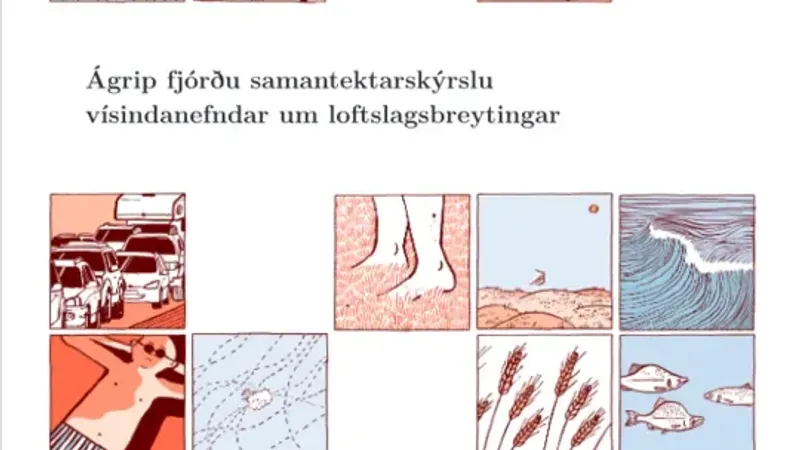
Summary Report of the Scientific Committee on Climate Change
The Scientific Committee on Climate Change was appointed by the Minister for the Environment, Energy and Climate in 2021. The Committee was tasked with preparing a report on the impacts of climate change on nature and society in Iceland. The report was published in autumn 2023.